
Between June and November 2025, Elevation delivered a series of environmental offsetting projects for the Province of British Columbia at four locations along Highway 5: Brodie Bridge, Murray Flats, Bottletop Bridge, and Juliet Bridge, all located approximately 50 kms south of Merritt.
These works were undertaken to address impacts on fish and fish habitat resulting from the Province of B.C.’s Highway Reinstatement Program and emergency repairs following the November 2021 flood event.
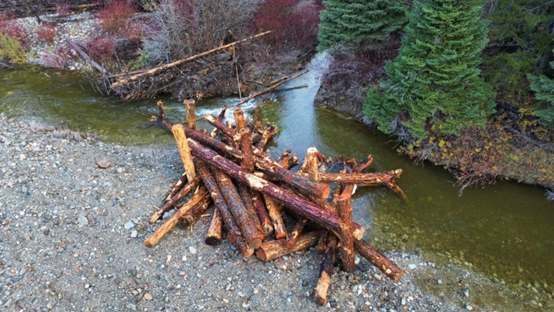
Restoring habitat along the Highway 5 corridor
The project focused on enhancing aquatic and riparian ecosystems between Hope and Merritt. Crews completed stream restoration, riparian planting, and habitat improvements tailored to each site’s ecological conditions. Key activities included:
These enhancements support long‑term habitat recovery and improve conditions for fish species affected by previous infrastructure damage.
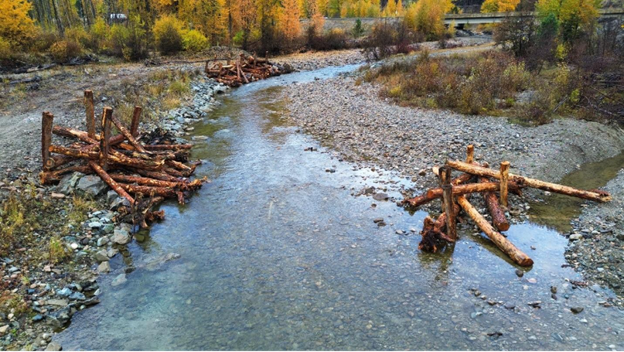
Efficient project delivery
Elevation served as the prime contractor, providing Ministry of Transportation and Transit Representation and on‑site supervision throughout construction. Our team provided full construction management support, including safety planning, utility coordination, cost tracking, reporting, quality management, and stakeholder liaison. Drone flights were also conducted to document progress and site conditions.
Key challenges
Despite the project’s remote locations and environmental sensitivities, the team successfully navigated several challenges:
Wildfire near Juliet Bridge: A nearby wildfire prompted a temporary closure of Highway 5 and evacuation of the site on September 4 and 5, 2025. Work resumed safely on September 8, 2025 with no major schedule impacts.
Large Woody Debris (LWD) procurement: Securing the required volume of LWD was challenging due to wildfire‑season logging constraints. Thanks to strong coordination with a First Nations supplier, all materials were delivered on time.
Alternative access routes: When original access routes required permits that were not issued before construction, the team identified and field‑fit alternative routes, supported by secondary utility permits, ensuring uninterrupted site access.
Lessons learned
Our team learned several valuable lessons on these projects which will help prepare us for future projects:
Weather and seasonal preparation: Variable winter conditions - particularly frozen topsoil - highlighted the importance of preparing for unpredictable weather patterns.
Coordination with local contractors and the Ministry of Transportation and Transit: Frequent schedule changes underscored the value of proactive, ongoing communication with the ministry and other contractors working in the corridor.
Contractor collaboration: Strong cooperation between the two contractors enabled resource sharing and efficient equipment use, contributing to on‑time, under‑budget delivery.
Wildfire preparedness: Having firefighting tools on site and monitoring wildfire conditions daily reinforces the need for a clear evacuation plan in wildfire‑prone regions.